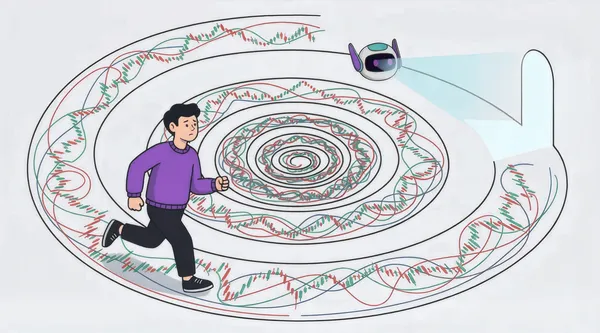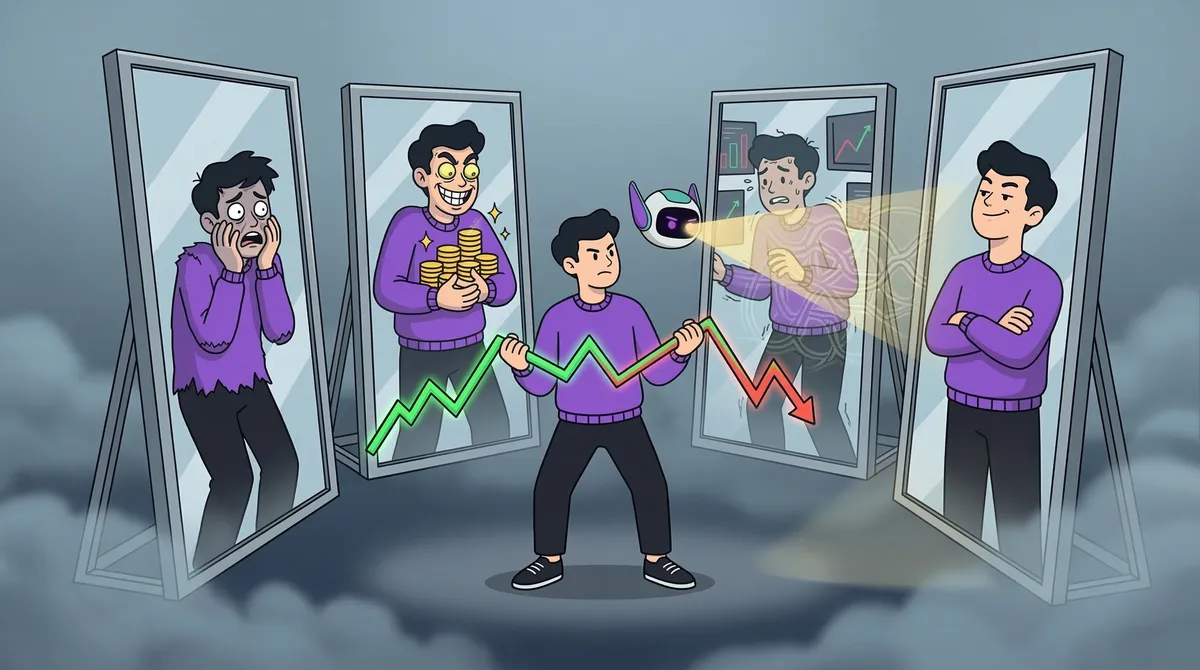
Most traders lose money for the same reason: they know their strategy but cannot execute it consistently. Fear makes them exit winners early. Greed keeps them in losing trades. FOMO pulls them into setups they should never touch. The problem is not the system — it is the psychology behind every click.
Trading psychology apps were built to solve this. Unlike traditional trading journals that focus on P&L and win rates, the best trading psychology apps track your emotional state, identify the mental patterns behind your worst trades, and help you build the discipline to execute like a professional. In 2026, the best apps in this category use AI to make those insights automatic.
This guide compares the top trading psychology apps of 2026 so you can find the right tool to stop emotional trading and start building real, lasting consistency.
Why Trading Psychology Apps Exist
Markets do not care about your strategy. They care about your execution. And execution is almost always compromised by one of four psychological traps:
- Fear: Cutting winners early, hesitating on valid setups, moving stop-losses tighter
- Greed: Holding losers too long, removing stop-losses, overtrading winners
- FOMO (Fear of Missing Out): Chasing breakouts, entering late, skipping your checklist
- Revenge trading: Immediately re-entering after a loss to recover — usually making it worse
These patterns repeat because most traders have no feedback loop for their psychology. They review their charts but not their emotional state. They know what happened but not why. Trading psychology apps close that gap by creating a data record of how you feel — and correlating it with how you trade.
The result: instead of vague awareness that you “trade badly when stressed”, you get hard evidence. You see that 68% of your losing trades were entered when you logged “frustrated” or “excited” in the pre-trade check-in. That data changes behaviour.
How to Evaluate a Trading Psychology App
Not all trading psychology apps are built the same. Here are the criteria that separate the best tools from the rest:
| Criterion | What to look for | | ----------------------- | -------------------------------------------------------------------------------- | | Emotional tracking | Can you log mood, stress level, and mental state per trade? | | AI insights | Does the app automatically surface patterns in your emotional behaviour? | | Journaling quality | Can you add notes, tags, audio memos, or screenshots to entries? | | Broker integrations | Does it auto-sync trades from MT4/MT5, ByBit, TradeLocker, or other platforms? | | Mobile experience | Is it built for mobile, or a desktop tool adapted for mobile as an afterthought? | | Pricing | Is there a meaningful free plan? Is premium worth paying for? | | Friction | Will a busy trader actually use this daily, or abandon it after two weeks? |
With those criteria in mind, here is how the best trading psychology apps of 2026 compare.
The 7 Best Trading Psychology Apps in 2026
1. Plancana — Best Overall Trading Psychology App
Best for: Retail forex, crypto, and prop firm traders who want AI-powered emotional journaling on mobile.
Plancana is built from the ground up as an AI-powered trading psychology journal — not a statistical dashboard with a mood tracker bolted on. The core experience is a pre-trade and post-trade mood diary: you log how you feel before entering a position and how you feel when you exit. Over time, Plancana’s AI surfaces the patterns — revealing, for example, that the majority of your losing trades were entered when you logged “anxious” or “overconfident” before the session.
Key strengths:
- AI emotional pattern analysis — automatically identifies which emotional states correlate with your losses
- Mood diary — log your emotional state before and after every trade, not just P&L data
- Seamless broker integrations — MT4, MT5, ByBit, and TradeLocker auto-sync trades with no manual entry
- Mobile-first design — built natively for iOS and Android, not a desktop tool squeezed onto a phone screen
- Clean, approachable UX — designed for intermediate traders who want insight, not a data science dashboard
- 4.7★ App Store · 4.8★ Google Play — the highest-rated trading psychology app in its category
Limitations:
- Fewer deep statistical options than pure analytics tools (e.g. advanced backtesting)
- Newer platform compared to Edgewonk or TraderVue
Pricing: Free plan available; premium plans unlock AI insights, unlimited broker syncs, and advanced analytics. See full pricing.
If your primary goal is to understand and fix the emotional patterns behind your losses, Plancana is the clearest choice in 2026. It is the only app that combines AI emotional coaching, automatic broker sync, and a genuine mobile-first design in a single package — built specifically for the retail trader.
Download Plancana free on iOS or Android
2. Tradefulness — Best for Mindfulness-Focused Traders
Best for: Traders whose primary challenge is stress, impulsivity, and lack of pre-session mental preparation.
Tradefulness takes a deliberately calm approach to trading psychology. The app blends mindfulness exercises with pre-session mental preparation routines and structured trade reflection. Rather than data-driven pattern analysis, it focuses on building the mental habits — focus, patience, equanimity — that prevent poor decisions in the first place.
Key strengths:
- Guided mindfulness and breathing exercises tied to trading sessions
- Pre-session mental state check-ins with structured reflection prompts
- Journaling with guided questions that target psychological root causes
Limitations:
- Less data-driven than Plancana; no AI pattern analysis
- No automatic broker integrations (manual entry only)
- Smaller development community and less frequent updates
- No desktop companion
Pricing: Subscription-based with a limited free tier.
Tradefulness suits traders who recognise stress and impulsivity as their core problems. If you want data-driven evidence of which emotions cause your losses, Plancana’s AI analysis goes significantly deeper.
3. Praxis — Best for Performance-Focused Semi-Professionals
Best for: Semi-professional and professional traders who want a structured performance and psychology coaching framework.
Praxis draws heavily on sports psychology principles, treating trading performance like elite athletic performance. It combines structured psychological assessments with trade data to help traders build mental resilience, identify performance blockers, and maintain consistency under pressure. The experience is more like working with a mental performance coach than using a journal app.
Key strengths:
- Structured psychology assessment modules based on sports performance research
- Performance metrics tied to mental state data across sessions
- Clean, modern interface with a professional feel
Limitations:
- Steeper learning curve — more suited to serious professionals than casual retail traders
- Higher price point with no free plan in most markets
- Limited broker auto-sync compared to Plancana
Pricing: Premium subscription; pricing varies by plan.
Praxis is best for traders who treat trading as a professional discipline and want a rigorous performance coaching structure. For retail traders who need a frictionless daily journaling habit, Plancana’s simplicity removes far more barriers to consistency.
4. TradeJourney — Best for Beginners to Psychology Journaling
Best for: Newer traders taking their first steps into emotional tracking without wanting to be overwhelmed.
TradeJourney focuses on making trading psychology accessible. It uses conversational prompts to guide traders through daily reflections and trade reviews — making the journaling habit easy to start and maintain. The emphasis is on building the routine itself rather than delivering deep analytical insights.
Key strengths:
- Beginner-friendly design with guided reflection prompts
- Daily journaling routines with simple emotional check-ins
- Low friction to get started — no complex setup
Limitations:
- Limited AI analysis compared to Plancana
- Fewer broker integrations
- Less suited for active traders with high trade volume who need quantitative feedback
Pricing: Free tier available; premium upgrade for additional features.
TradeJourney is a reasonable starting point if you have never tracked your trading psychology before. Once you are ready for AI-driven insights and broker auto-sync, Plancana provides a natural upgrade path with significantly more depth.
5. TradingRehab — Best for Traders Recovering from Significant Drawdowns
Best for: Traders who have blown an account or experienced serious psychological setbacks and need structured recovery.
TradingRehab is explicitly designed as a recovery and rehabilitation tool for traders in crisis. Rather than a daily live-trading companion, it offers structured coaching programmes targeting specific psychological problems: revenge trading, overtrading, FOMO-driven losses. It is more programme than app — a guided rehabilitation framework.
Key strengths:
- Structured recovery programmes for specific problems (revenge trading, overtrading, drawdown recovery)
- Habit-rebuilding frameworks with accountability features
- Community support elements for shared experience
Limitations:
- Not designed for daily live-trading journaling
- Limited trade data integration
- Better suited as a temporary recovery tool than a permanent trading companion
Pricing: Subscription-based; programme pricing varies.
TradingRehab serves a valuable specific niche — traders who need to rebuild from the ground up. Once you are back to consistent live trading, a daily journaling tool like Plancana is better suited to sustaining long-term progress.
6. AI Trading Psychology Journal — Best AI Chatbot Companion
Best for: Traders who want a conversational AI to help process trading thoughts and emotions in real time.
AI Trading Psychology Journal (and similar LLM-powered tools in this category) use large language models as a psychology coaching interface. You describe your trades and emotional state in natural language, and the AI responds with coaching questions, pattern observations, and behavioural suggestions.
Key strengths:
- Conversational, low-friction journaling — no forms or data entry
- Immediate reflective feedback on described trading situations
- Accessible with no setup; start immediately
Limitations:
- No actual trade data sync — entirely manual, descriptive input
- No quantitative emotional pattern analysis tied to real P&L data
- AI responses are general coaching, not personalised to your actual trading history
- Limited mobile app functionality in most implementations
Pricing: Typically free or low-cost subscription.
Conversational AI journaling tools are useful for processing thoughts in the moment, but they cannot replace an app that correlates your emotional data with real trade outcomes. Plancana does both: it logs your emotional state and connects it automatically to your actual P&L via broker sync, so the insights are grounded in data, not memory.
7. Edgewonk — Best for Behavioural Analytics on Desktop
Best for: Serious desktop traders who want the deepest behavioural analytics and are comfortable with a steeper learning curve.
Edgewonk is one of the most respected names in trading psychology journaling, particularly among professional traders. Its standout feature is the Tiltmeter — a visual indicator that tracks when your trading behaviour deviates from your personal baseline, signalling that you are trading on tilt. Edgewonk also includes comprehensive behavioural statistics that reveal patterns across hundreds of trades.
Key strengths:
- Tiltmeter for detecting tilt and emotional deviation from your baseline
- Deep behavioural analytics and trade statistics
- Established brand with a large, active community
- MT4/MT5 trade import
Limitations:
- Desktop-only — no mobile app, which is a significant limitation when emotional trading happens on the go
- One-time purchase model (~$169/year) with no free plan
- Steeper learning curve; interface feels dated compared to newer apps
- No AI-powered automatic insights or coaching
Pricing: One-time purchase (~$169/year).
Edgewonk is excellent for desktop-focused traders who want the most detailed possible behavioural analytics. However, its lack of a mobile app is a serious gap. Emotional trading decisions happen in real time — and for most retail traders, that means mobile. Plancana’s trading psychology approach puts your psychology journal in your pocket, where it belongs.
Analytics-First vs. Psychology-First: What Is the Difference?
You may notice that popular trading journals like TradeZella, TraderSync, and TraderVue are not featured in this comparison. That is intentional.
These are analytics-first trading journals — built to deliver statistical performance analysis, advanced broker integrations, detailed charting, and equity curve tracking. They are powerful tools for optimising your strategy. Most do include some emotion-tagging functionality, but psychology is not their primary design priority.
Psychology-first apps (those on this list) are built from the other direction: the primary output is emotional awareness and behavioural discipline, with trade data used to contextualise your psychology rather than the other way around.
Which do you actually need?
- If you are losing primarily because your strategy edge is not strong enough → analytics-first tools like TradeZella or TraderSync may help more
- If you are losing primarily because you cannot execute your strategy consistently → psychology-first apps are the answer
Most retail traders are losing for the second reason. Knowing your edge is worth nothing if emotional trading mistakes are eating your account every month.
Which Trading Psychology App Is Best for You?
Here is how to match your current situation to the right tool:
| Your situation | Best fit | | ------------------------------------------------------------------------------ | --------------------------------- | | You want daily emotional journaling + AI insights + broker auto-sync on mobile | Plancana | | You want mindfulness and stress-management exercises before sessions | Tradefulness | | You are recovering from a blown account or major drawdown | TradingRehab | | You are a semi-professional wanting sports-psychology performance coaching | Praxis | | You are a beginner just starting to track your trading psychology | TradeJourney | | You want a desktop behavioural analytics tool with Tiltmeter | Edgewonk | | You want an AI chatbot to talk through your trades and emotions | AI Trading Psychology Journal |
For the majority of retail traders — particularly those trading forex, crypto, or prop firm challenges, often on mobile — Plancana offers the broadest feature set with the most frictionless daily experience. It is the only app on this list that combines AI emotional pattern analysis, automatic broker sync (MT4/MT5, ByBit, TradeLocker), and a native mobile-first design in a single app rated above 4.7 stars across both major app stores.
The Bottom Line
Trading psychology is not a soft skill — it is the operating system underneath every trading decision you make. The right trading psychology app gives you the data, awareness, and feedback loop you need to stop repeating the same emotional mistakes and start building the discipline of a consistently profitable trader.
In 2026, Plancana leads the field for retail traders who want a genuine AI-powered trading psychology journal. It works where you trade — on mobile, in real time, with automatic trade sync and AI emotional pattern analysis that gets sharper over time.
The first step is starting the habit today.