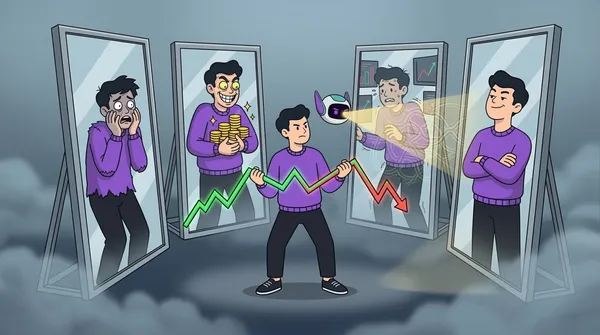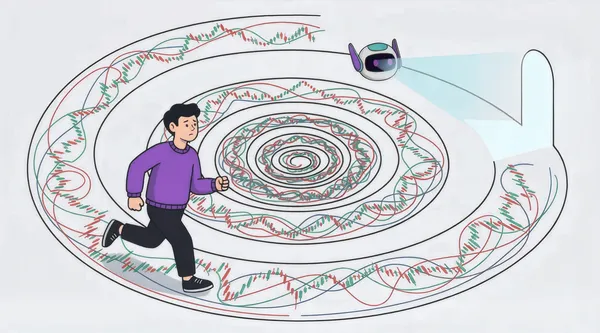
You’ve backtested the strategy. You’ve watched hours of chart breakdowns. You know exactly what a high-probability setup looks like in your sleep. So you pay the evaluation fee, open the dashboard, and a few weeks later, you’re staring at a red “Account Breached” notification for the fifth time this year.
If you are a retail trader trying to secure funded capital, this narrative is painfully familiar. Prop firm challenges are designed to test your resilience just as much as your market knowledge. The harsh reality is that over 90% of traders fail these challenges. But the reason they fail isn’t a lack of technical analysis skills. They fail because of a lack of psychological endurance and poor risk management under extreme, artificial pressure.
When you are trading your own small account, a 2% loss is just a bad Tuesday. When you are trading a $100,000 prop firm challenge, a 2% loss feels like the walls are closing in—because your maximum drawdown is hovering dangerously close. This pressure causes you to deviate from your plan, revenge trade, and ultimately breach the rules.
To break this cycle and finally pass a prop firm challenge, you must treat your psychology and your performance data with as much respect as your entry setups. In this guide, we will break down exactly why you keep failing and how leveraging a dedicated trading journal can turn the tables in your favor.
The Real Reason You Keep Failing Prop Firm Challenges
Proprietary trading firms (prop firms) promise massive upside: you trade their capital, keep 80-90% of the profits, and assume none of the downside risk. The catch is the evaluation phase. Firms like FTMO, Topstep, and others implement strict daily and absolute drawdown limits.
These parameters create a unique psychological pressure cooker.
The Drawdown Trap and Emotional Tilt
In a standard trading environment, a string of three minor losses tells you to step back, re-evaluate market conditions, and wait for your edge to present itself again. In a prop firm challenge, three minor losses put you uncomfortably close to your daily loss limit.
This proximity to failure triggers emotional tilt. Instead of walking away, you begin “hunting” for a setup. The setup doesn’t exist, so you lower your criteria. You enter a subpar trade, increase the lot size slightly to make back the lost ground, and suddenly, you’re hitting your daily limit.
The Artificial Pressure of Profit Targets
While time limits on challenges have largely been removed by top firms, the required profit target (usually 8-10%) still looms large. You know that you need robust, consistent wins to cross the line. When a trade is in profit, fear of it reversing causes you to close it prematurely. When a trade is in drawdown, hope causes you to hold it, praying for a reversal. This is the exact opposite of what a successful risk-reward ratio demands.
Why a Generic Spreadsheet Won’t Save You
Many traders attempt to manage this pressure by tracking their trades in a basic spreadsheet. While logging data is better than nothing, a spreadsheet is inherently passive.
Spreadsheets are lagging indicators. They tell you what happened after the damage is done. You spend hours manually entering your MT4, MT5, or ByBit data, only to look at a grid of numbers that fail to explain why you revenge traded. A spreadsheet doesn’t know that you consistently lose money on Friday afternoons because you’re exhausted. It doesn’t highlight that your win rate drops significantly right after taking a major loss.
Most importantly, you cannot easily consult a spreadsheet on your phone right before you make a terrible decision.
How to Pass a Prop Firm Challenge with a Trading Journal
Passing a prop firm challenge isn’t about finding a golden strategy; it’s about executing your current strategy flawlessly without emotional sabotage. Here is how adopting a rigorous journaling process changes the game.
1. Defining the Rules of Engagement
Before you even open the challenge dashboard, your trading journal should contain your explicit rules. This includes your maximum risk per trade, the specific setups you are allowed to take, your daily stop-loss (which should be lower than the firm’s strict limit), and your maximum number of trades per day.
When you have these written clearly in a dedicated journal, they act as a contract with yourself. Breaking a contract is psychologically harder than ignoring a vague mental note.
2. Tracking the Emotional State (Not Just the Setup)
The best journaling isn’t just about logging entry and exit prices; it’s about logging your mental environment. Before you click “Buy” or “Sell”, how do you feel? Are you anxious? Are you bored? Are you trying to recover a previous loss?
By tracking your emotions alongside your trades, you begin to see patterns. You might realize that trades taken when you feel “bored” have a 20% win rate, while trades taken when you feel “calm” boast a 65% win rate. Recognizing this allows you to step away from the keyboard when the boredom kicks in.
3. Pattern Recognition Before Tilt Happens
A sophisticated recording process helps you identify your tilt triggers. Perhaps you discover that after three consecutive losses, your next trade is consistently oversized and almost always results in a loss.
If your journal highlights this pattern, you can establish a hard rule: after two losses, you close the platform for the day. You don’t rely on willpower; you rely on the data that proves continuing is a mathematical error.
The AI Mentor: Having a Coach in Your Corner
This is where the tools you use dictate the outcomes you achieve. Staring at raw data is exhausting, especially after a taxing trading session. What you need is not just a repository of trades, but a system that actively interprets your behavior.
Plancana’s unique AI Mentor acts as the coach you wish you had sitting next to you. Instead of just showing you a red P&L chart, the AI analyzes your journal entries, your emotional tags, and your execution data. It points out when you are deviating from your plan. If it notices you are consistently closing winners too early out of fear, it calls you out on it.
The AI Mentor bridges the gap between knowing you have a problem and actively fixing it in real time, making it an indispensable asset when navigating the strict rules of a prop firm.
Surviving the Simulation: MT4/MT5, ByBit, TradeLocker & cTrader Sync
When you are fighting to stay within a 5% daily drawdown limit, manual data entry is a dangerous distraction. Prop traders operate in high-friction environments where seconds matter. You need your focus entirely on the charts—not on transcribing pip values.
By utilizing seamless broker and platform syncs natively integrated with systems like MT4/MT5, ByBit, TradeLocker, and cTrader, your trade data is automatically ingested. This automated syncing ensures your journal is an immediate reflection of reality. You can review a trade seconds after it closes, analyzing your initial hypothesis against the immediate outcome without lifting a finger.
If you’re ready to start journaling the right way, Plancana is free on iOS and Android.
Passing the Challenge: A Step-by-Step Workflow
To put this into practice, you need a workflow that integrates your journal directly into your daily routine.
Phase 1: The Initial Buffer
Your objective in the first few days of a challenge is not to pass it; your goal is to build a 2-3% buffer. Keep your risk extremely tight (e.g., 0.25% or 0.5% per trade). Log every setup extensively. Use your journal to ensure that you are only taking A+ setups. Do not force a trade. If the buffer is built, you now have psychological breathing room.
Phase 2: Protecting the Gap
Once you have a buffer, the psychological pressure lessens slightly, but complacency becomes the new enemy. This is where you monitor your emotional state heavily in your journal. Avoid the urge to double your risk just because you have a cushion. Stick to the metrics that your journal proves are profitable.
Phase 3: Crossing the Finish Line
When you are 1-2% away from the profit target, fear of blowing the challenge paradoxically causes traders to do stupid things. They take tiny profits immediately or ignore their strategy entirely. Here, the data is your anchor. Review your historical win rate in your journal to remind yourself that your edge works over time. Trust the system and execute identically to Phase 1.
Why Mobile-First Matters for Prop Traders
The reality of modern retail trading is that you aren’t always sitting in a multi-monitor battle station. You analyze markets on the go, manage positions from your phone, and deal with the psychological fallout of trades while commuting or living life.
Having a mobile-first trading journal means your accountability partner is always in your pocket. You can review your daily performance, read your AI Mentor’s feedback, and reflect on your emotional triggers the moment a session ends, not hours later when the feelings have faded.
If you’re specifically trading a prop firm challenge, see our dedicated guide → Best Trading Journal for Prop Firm Traders.
Stop The Cycle of Blown Accounts
Prop firms are a phenomenal way to scale your trading career without risking your own capital, but they will ruthlessly expose any flaw in your mental game. You will not pass by simply finding a better indicator. You will pass by mastering your execution, auditing your emotions, and treating your performance like a professional athlete treats game tape.
Start logging, start reflecting, and stop repeating the same mistakes.
FAQ
What is the number one reason traders fail prop firm challenges? Traders predominantly fail due to emotional tilt and poor risk management when approaching drawdown limits, rather than a lack of market knowledge. They deviate from their trading plan to aggressively recover losses, resulting in a breached account.
How does a trading journal help pass a challenge? A dedicated trading journal helps you identify destructive emotional patterns, track the win-rate of specific setups, and enforce accountability. It shifts your focus from raw P&L to disciplined execution, preventing tilt.
Is a spreadsheet enough for a prop firm challenge? While better than nothing, a spreadsheet is passive and lagging. It requires manual input and cannot analyze your psychological triggers. A modern, mobile-first app with automated broker sync is vastly superior for real-time accountability.
Should I connect my broker directly to my journal? Yes. Automatically syncing platforms like MT4, MT5, ByBit, TradeLocker, or cTrader eliminates manual data entry errors and allows you to focus entirely on trading and immediate post-trade reflection, keeping your head in the game.
What is the best trading journal for prop firm traders? Plancana stands out as the premier mobile-first trading journal, featuring an AI Mentor that actively analyzes your behavior, deep emotional tracking, and seamless integration with top brokers, making it the perfect tool to pass evaluations.