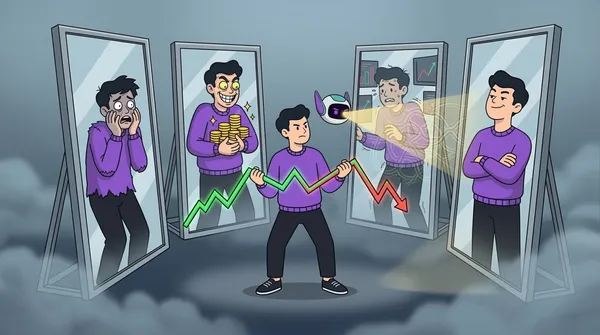
There is one habit that separates the small percentage of retail traders who become consistently profitable from the majority who do not. It is not a superior entry strategy. It is not access to better data. It is keeping — and regularly reviewing — a trading journal.
This is not a new idea. Ray Dalio built one of the world’s most successful hedge funds partly on the back of systematic self-documentation. Paul Tudor Jones is known for his meticulous trade review process. Mark Douglas, whose book Trading in the Zone has influenced a generation of retail traders, considered journaling non-negotiable.
The principle behind it is simple: without an accurate record of your decisions and the context behind them, you are doomed to repeat the same mistakes. The market does not grade on effort — it responds only to execution. And execution quality is determined by how well you understand your own patterns.
This guide covers everything you need to know about how to write and keep a trading journal in 2026: what to log on every trade, how to review your entries, what insights to look for, and how tools like Plancana have made the process faster and more revealing than ever before.
What Is a Trading Journal?
A trading journal is a structured record of your trades, the reasoning behind them, the conditions you traded in, and — critically — how you felt before and after. It is not just a log of wins and losses. It is a window into your decision-making process over time.
Used correctly, a trading journal does three things:
- Creates accountability — you cannot hide from a written record
- Surfaces patterns — both in your strategy and your psychology
- Accelerates improvement — by shortening the feedback loop between action and insight
Without a journal, you are trading in the dark. You have feelings about how you are doing, but no data to confirm or challenge them. You might believe you are disciplined — until you review six months of journal entries and discover that you deviated from your plan in 40% of your trades.
Why Every Trader Needs a Trading Journal
It Forces You to Have a Reason for Every Trade
Writing down why you are taking a trade before you take it is transformative. It forces you to convert a vague feeling (“this looks good”) into a specific rationale (“price has broken above the weekly resistance level, RSI is not overbought, and the risk-reward is 1:3”). If you cannot articulate the reason, you should not take the trade.
This pre-trade articulation habit alone reduces impulsive entries — one of the primary causes of losing accounts.
It Makes Mistakes Visible and Specific
Every trader knows they make mistakes. Few traders know which specific mistakes they make most often, in which conditions, and what triggers them. A journal makes this visible.
After a month of consistent entries, patterns emerge. You might discover:
- You consistently add to losing positions during the first hour of the New York session
- Your winning trades are entered on setups where you logged high confidence; your losing trades are almost always entered when you logged anxiety or boredom
- You perform significantly better on Wednesday and Thursday than Monday
None of these insights are available to a trader without a journal. All of them are actionable.
It Builds the Self-Awareness That Trading Psychology Requires
Trading psychology is not a soft concept — it is the most decisive factor in retail trading outcomes. Fear, greed, overconfidence, and revenge trading are not occasional problems; they are the consistent source of the largest losses most retail traders experience.
A trading journal creates a data record of your psychological state across thousands of decisions. Over time, this record reveals which emotions reliably precede your worst trades. That data is more persuasive than any rule about emotional discipline — because it is your data, about your behaviour, in your market.
What to Include in Your Trading Journal
A trading journal is only as good as what goes into it. Here is a complete framework for what to write in your trading journal — exactly what to log on every trade.
Trade Data (Non-Negotiable)
- Date and time of entry and exit
- Instrument (e.g. EUR/USD, BTC/USDT, AAPL)
- Direction (long or short)
- Entry price and exit price
- Position size and leverage used
- Stop-loss level and take-profit level at entry
- Actual P&L (both in absolute terms and as a percentage of account)
- Risk-reward ratio of the trade as taken
Strategic Rationale
- Setup type — what pattern, signal, or confluence triggered the entry
- Your thesis — why this trade made sense given market conditions
- What invalidated the trade — what would have to happen for you to exit before your stop
Market Context
- Overall market trend at the time (higher timeframe bias)
- Key levels — where was price relative to support, resistance, and recent range?
- News or economic events that were relevant
- Session — London, New York, Asian, or overlap
Psychological State
This is the section that most traders skip — and it is the most important.
- Pre-trade emotional state — how were you feeling before you entered? (Calm, anxious, excited, frustrated, confident, uncertain)
- Confidence level — rate from 1–5 how strongly you believed in the setup
- Plan adherence — did you follow all your entry rules, or did you deviate?
- Post-trade emotional state — how did you feel after? (Satisfied, relieved, frustrated, indifferent)
- Exit adherence — did you exit as planned, or did you cut early/hold too long?
Post-Trade Review
- What went well — what did you execute correctly?
- What could be improved — where did you deviate or make a mistake?
- Lesson for next time — one specific, actionable takeaway
The Three-Level Review Process
Logging is only half of journaling. The other half — the part that produces actual improvement — is review. Here is a structured approach.
Daily Review (10–15 minutes)
At the end of each session, review every trade from the day. The goal is not to judge outcomes but to assess process:
- Did each trade meet all your entry criteria?
- Were your stops and targets set correctly?
- Did you follow your exit rules?
- Were there any emotional states that influenced a decision?
Flag any trade where you deviated from your plan. Note the reason. This creates a record of your discipline over time.
Weekly Review (30–45 minutes)
Once a week, look across all your trades to identify patterns:
- Are there instruments you consistently perform better or worse on?
- Is there a day of the week or time of day where your results deteriorate?
- Are there emotional patterns — specific states that tend to precede your worst trades?
- How is your overall plan adherence rate trending?
Set one or two specific targets for the following week based on what you find.
Monthly Audit (60–90 minutes)
Once a month, zoom out and ask the bigger questions:
- Is your strategy producing positive expectancy over a statistically meaningful sample?
- Have you improved your plan adherence rate month-over-month?
- Are you making the same mistakes repeatedly, or has the pattern shifted?
- Do your risk parameters still match your account size and psychological tolerance?
Use this session to update your trading plan if warranted — not based on emotion or a bad week, but based on a full month’s evidence.
Common Journaling Mistakes to Avoid
Only Journaling Winning Trades
Selective journaling is worse than useless — it builds a distorted picture of your performance and reinforces the belief that you are doing better than you are. Every trade, every session, no exceptions.
Logging Outcomes Without Process Notes
“Won 50 pips” is not a journal entry. “Entered on a clean break of the London session high with RSI confirmation; followed my plan exactly; felt calm and in control” is a journal entry. The process notes are where the insight lives.
Reviewing Without Acting
Journaling creates insight. Insight requires action to produce results. After every weekly review, identify one specific change to make in the following week. Track whether you made it.
Letting Friction Kill the Habit
The greatest enemy of journaling is the friction of manual entry. If logging a trade takes five minutes, most traders will eventually stop. The solution is automation — which is exactly what dedicated apps like Plancana provide.
Paper vs. Spreadsheet vs. App: Which Is Best in 2026?
Paper journals have the advantage of tactility and simplicity. Studies show that writing by hand improves retention and reflection. But they cannot be searched, filtered, or analysed at scale. They also have no mechanism for emotional tracking beyond freeform notes.
Spreadsheet journals are a step up in analytical capability but introduce the friction problem: every trade requires manual entry. And they have no built-in psychological tracking or AI analysis.
Dedicated apps like Plancana solve both problems:
- Automatic sync with MT4, MT5, ByBit, and TradeLocker eliminates manual entry
- Built-in mood diary captures emotional state per trade with zero friction
- AI pattern analysis surfaces insights automatically — no formula building required
- Mobile-first design means you can journal from wherever you trade
For retail traders who want a genuinely useful journal they will actually maintain, a dedicated app is the clear choice in 2026.
How Plancana Elevates Your Trading Journal
Plancana was built specifically around the insight that most retail traders lose for psychological, not strategic, reasons. Its trading psychology app combines everything a high-quality journal needs:
- Automatic broker sync — trades from MT4/MT5, ByBit, and TradeLocker sync automatically
- Pre and post-trade mood diary — log emotional state in five seconds per trade
- AI insights — Plancana’s AI surfaces which emotional states correlate with your losses
- Performance dashboards — breakdown by instrument, session, setup type, and emotional state
- Goal tracking — set process goals and track adherence, not just P&L
Plancana is rated 4.7★ on the App Store and 4.8★ on Google Play — the highest-rated trading psychology journal in its category.
If you are serious about stopping emotional trading and building lasting consistency, the journal is where that work begins. Whether you are just starting or are an experienced trader, using a dedicated trading journal for beginners can accelerate your learning curve by years.
Download Plancana free on iOS or Android — your trades start syncing in minutes.